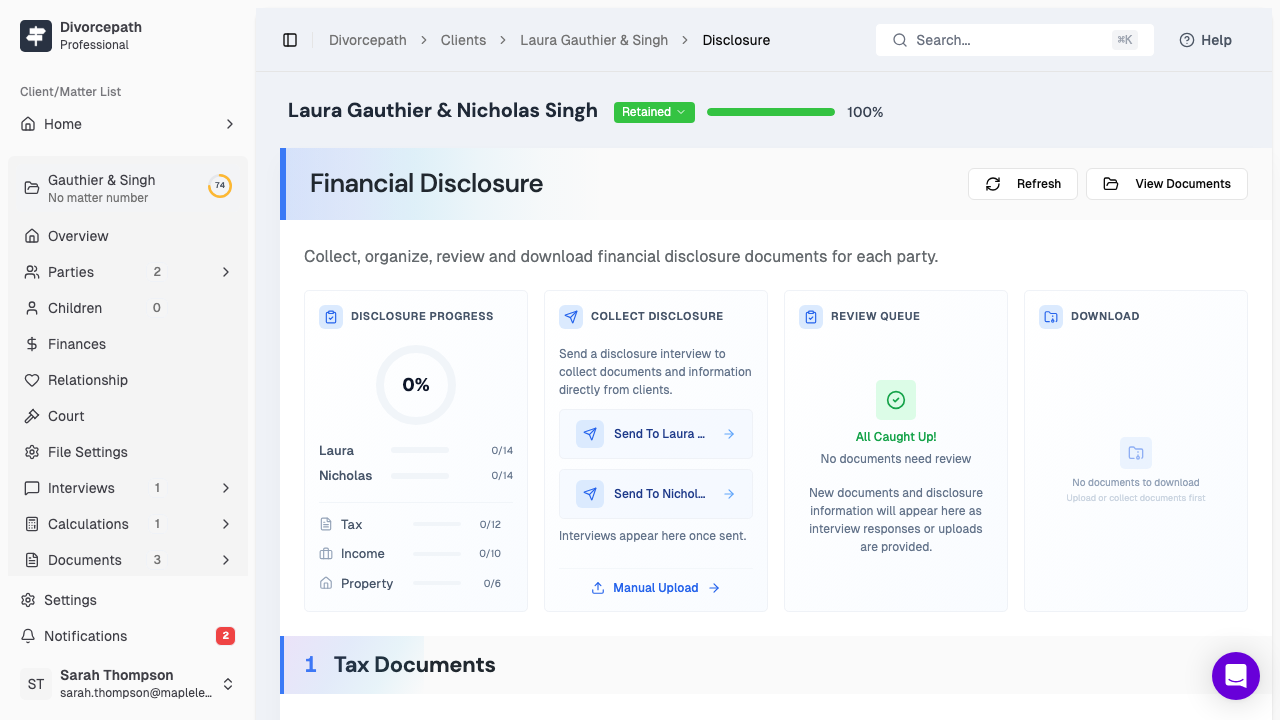
Financial disclosure is the formal process of exchanging financial information between parties in a family law matter. In Canada, both parties have a legal obligation to provide full, frank, and timely disclosure of their financial circumstances. Divorcepath streamlines this process by providing tools to send disclosure requests, track document status, and compare financial information side by side.
Why Financial Disclosure Matters
Financial disclosure is a cornerstone of family law proceedings in Canada. Courts require both parties to provide complete and accurate financial information before making decisions about support, property division, and other financial matters. Key reasons disclosure matters include:
- Legal obligation — parties are required by law to disclose their financial circumstances. Failure to do so can result in court sanctions, cost awards, or adverse inferences.
- Court requirements — judges rely on complete financial information to make fair and informed decisions. Incomplete disclosure can delay proceedings or lead to unfavourable outcomes.
- Fair negotiations — meaningful settlement discussions are only possible when both parties have a clear picture of the other's finances.
- Accuracy — support calculations and property division depend on accurate financial data from both sides.
How Divorcepath Streamlines Disclosure
Divorcepath provides a complete disclosure management workflow that helps you stay organized and on top of the process. Rather than tracking documents through emails and spreadsheets, you can manage everything directly within each client file. Key features include:
- Disclosure requests — send formal requests for specific financial documents to the other party via email.
- Document tracking — monitor the status of each requested document as it moves through the disclosure process.
- Status management — track whether documents have been requested, received, deferred, disputed, confirmed, or marked as not available.
- Comparative disclosure — view both parties' financial information side by side to identify discrepancies and missing documents.
The Disclosure Workflow
The typical disclosure workflow in Divorcepath follows these steps:
- Send disclosure requests — create a disclosure interview specifying the documents you need from the other party, and send it via email.
- Track document status — as the other party responds, track whether each document has been received, deferred, disputed, or marked as not available.
- Review received documents — examine the financial information provided and confirm receipt of documents that meet your requirements.
- Follow up on outstanding items — identify documents that are still missing, deferred, or disputed, and take appropriate action.
- Compare disclosures — use the comparative disclosure view to compare both parties' financial information and identify any discrepancies or gaps.
Getting Started
To begin managing financial disclosure for a client file, navigate to the Disclosure tab within the client file. From there, you can create disclosure requests, track document status, and access the comparative disclosure view. For detailed instructions on each step, refer to the following articles:
- Sending Disclosure Requests — learn how to create and send disclosure requests to the other party.
- Comparative Disclosure — learn how to use the side-by-side comparison view to analyse both parties' financial information.
